
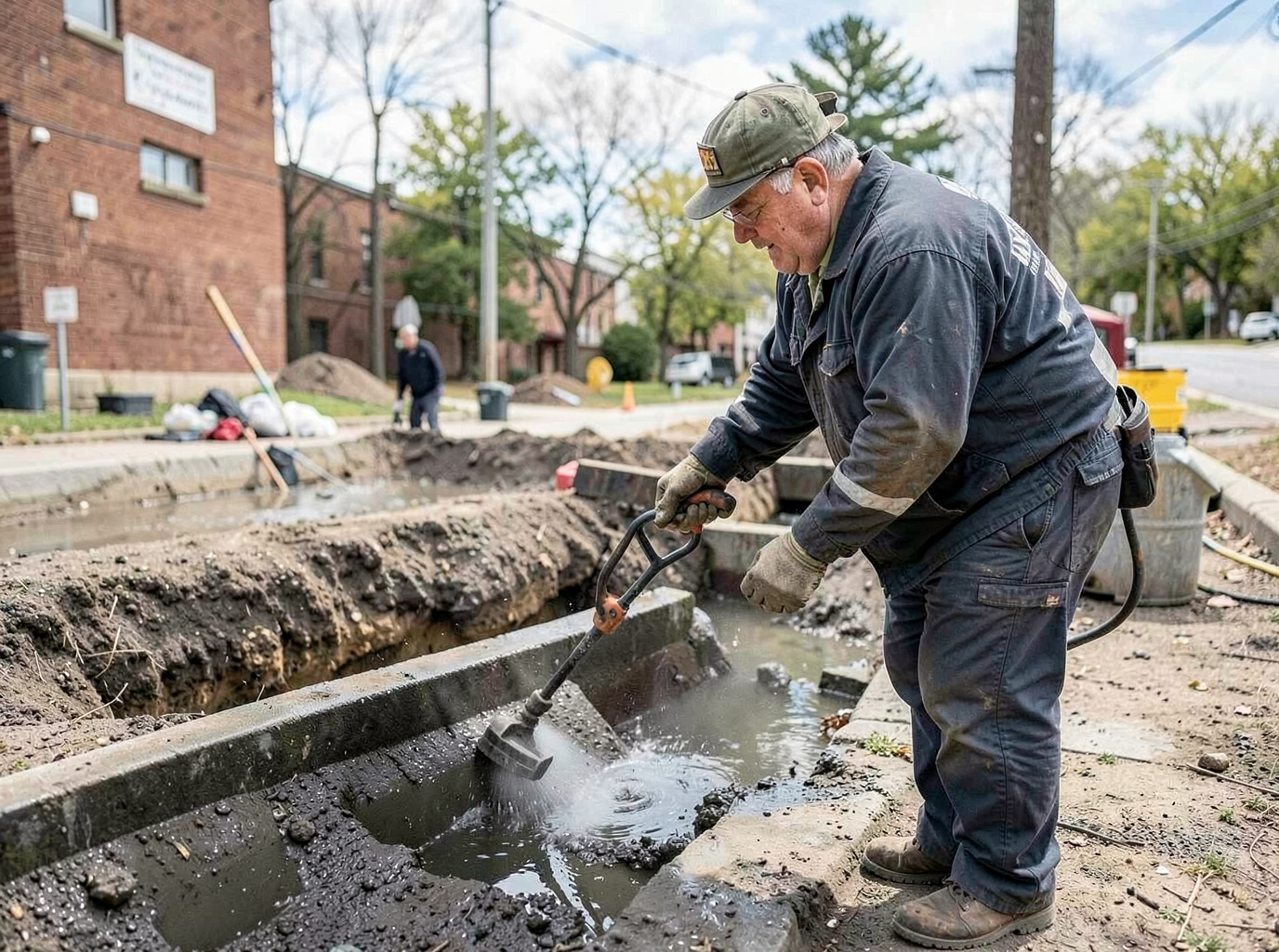
Storm drains in Lee's Summit face heavy leaf fall from mature trees around Legacy Park and Missouri Town 1855 plus sediment carried from the rolling terrain near Longview Lake. Cold winters cause repeated freeze-thaw expansion that cracks older clay and concrete lines installed before 1980 in neighborhoods such as Winterset and Chapel Hill. Summer thunderstorms drop several inches in hours, overwhelming inlets that have not been cleared of construction debris left from recent builds near Raymore and Grandview. Proper jetting reaches 150 feet or more without excavation when crews use the right head angles for the pipe diameter common on Jackson County residential streets.
Many properties in Raintree Lake and Downtown Lee's Summit still have 4-inch and 6-inch vitrified clay laterals that collect fine silt and gravel from nearby roadwork. High-pressure water alone can push debris into the main line if the operator does not first locate the cleanout and verify flow direction. Crews also check for root intrusion from silver maples planted decades ago along streets in Chapel Hill; these roots enter through mortar joints and create recurring blockages after every heavy rain. Documenting pipe condition with a camera before and after service prevents disputes and shows homeowners exactly where future problems are likely to form.
City code in Lee's Summit requires that storm water inlets on commercial lots remain clear to prevent street flooding that could affect traffic on roads leading to Kansas City. Residential properties near Winterset often have shared laterals that run under driveways; clearing only the visible grate leaves the line downstream restricted. Seasonal scheduling before November and again in March keeps lines open when cold weather reduces water flow and allows ice to form inside partially blocked pipes.
Technician insight
In Lee's Summit the thing that catches most people out with storm drain cleaning is the old clay laterals under driveways in Chapel Hill and Winterset; they crack during winter freezes and then fill with gravel from the street the first time a summer storm hits, so jetting alone rarely lasts unless the crack is noted and the homeowner knows the line will need lining later.
Backed-up inlet near Longview Lake
Water pooled in the street after a July storm on a property off 3rd Street. Camera showed a partial collapse and heavy silt in a 6-inch clay line running toward the lake. Jetting cleared the immediate blockage and flushed sediment to the main, restoring flow without excavation.
Storm Drain Cleaning Services We Offer
✓Catch Basin Cleaning
Removes accumulated leaves, silt, and gravel from surface inlets before they wash into laterals serving homes near Longview Lake.
✓Storm Sewer Jetting
High-pressure flushing of main storm lines to clear sediment and root buildup common in older Jackson County neighborhoods such as Chapel Hill.
✓Grate and Inlet Maintenance
Lifts and cleans metal grates plus the first few feet of pipe on residential and commercial properties around Downtown Lee's Summit.
✓Emergency Storm Drain Unclogging
Rapid response when heavy rain backs water into yards or streets near Raintree Lake or Winterset after sudden thunderstorms.
✓Commercial Parking Lot Drain Cleaning
Clears larger inlets and lines on retail and office lots that collect extra debris from vehicle traffic heading toward Grandview and Kansas City.
✓Driveway Drain Clearing
Targets shallow laterals under driveways in neighborhoods like Chapel Hill where gravel and mulch frequently wash in during summer storms.
Storm Drain Cleaning Cost in MO
| Service | Typical Range | What Affects It |
|---|---|---|
| Single catch basin cleaning | $175–$325 | Depth and sediment load affect time on site. |
| Residential storm lateral jetting | $250–$450 | Longer runs or root blockages increase cost. |
| Commercial inlet and line service | $350–$650 | Multiple inlets or shared mains raise the range. |
| Emergency after-hours response | $400–$700 | Weekend or evening calls add a premium. |
Ranges are typical for MO and confirmed with an exact written quote before any work starts.
How it works
- 1
Site Assessment
Locate all visible inlets and cleanouts on the property and note proximity to Longview Lake or Legacy Park drainage patterns.
- 2
Camera Inspection
Run a camera to identify blockages, pipe material, and any root intrusion before water is introduced.
- 3
High-Pressure Jetting
Use appropriate nozzle angles to scour walls and push debris toward the main without forcing material into downstream lines.
- 4
Debris Removal And Verification
Vacuum solids at the access point and run a final camera pass to confirm flow has been restored.
Pricing
Upfront quotes after on-site inspection; final price depends on access, pipe length, and debris volume.